The Era of Big Business is over
Originally published in Dutch in EW Magazine on June 16th 2021, this article was translated and adapted on the 23rd of August 2020.
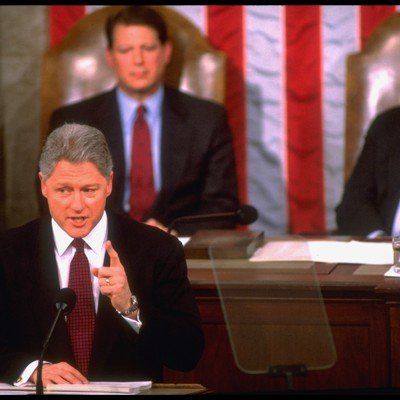
Basking in the afterglow of the end of the Cold War, US President Bill Clinton made a bold proclamation during his 1996 State of the Union. “The Era of Big Government is over”. He was rewarded with thunderous applause from both parties. Yet a little over a quarter century later, the more accurate statement might be: The Era of Big Business is over.
What he meant was that the large federal government that would actively intervene in pursuit of vanquishing Communism was no longer necessary. Geopolitics ceased being an obstacle, unpleasant regimes guilty of human rights violations presenting more of an unfortunate distraction than a systemic challenge. It was time to unleash the private sector.
Bill Clinton in his 1996 State of Union Speech
The heyday of corporations
This has been the dominant paradigm for the past 25 years. But recently we have seen this trend reverse. Instead of the private sector being given free rein, in particular multinationals are increasingly getting captured in a tightening web of geopolitics. Two specific developments lie at the heart of this development: rapidly changing technology, and the increasing awareness of the downsides of economic interconnectedness.
The rise of China as a systemic rival means that geopolitics is back with a vengeance. Especially on technology the Sino-US rivalty is forcing countries into exactly the type of strategic zero-sum decision making that is anathema to globalized free trade that has created some of the worlds most important corporations. The US indirectly halting any exports to China of ASML’s extreme ultraviolet (EUV) machines, critical in the production of advanced semiconductors, is only one such example. Simultaneously the EU is making considerable regulatory advancements on the use of data and artificial intelligence.
The business of government
Both national governments and transnational organizations such as the EU are making eager use of their regulatory power to reduce undesirable dependencies. This all is a clear manifestation of strategic imperatives overtaking purely market driven dynamics in what has been described as ‘innovation mercantilism’. That is to say, countries are trying to hoard technological innovation and maximize its adoption within their own spheres of influence while attempting to reduce any and all transfer of innovative technologies to strategic rivals.

While these trends predate the pandemic, COVID was a wake-up call with respect to the downsides of globalized economic supply chains. From the import of medical equipment to the Evergreen blocking the Suez Canal, the strategic risk of depending on global trade have become obvious, in particular after the Russian invasion of Ukraine. In particular Europe has had a rude awakening on the limitations of markets and free trade. Housing prices have soared while the current energy crisis and abysmal relations with Russia has discredited the German approach of mutually assured dependence. Economic self interest and even economic nationalism is in vogue on both sides of the Atlantic.
Both of these components, the innovation mercantilism and the realization that globalized supply chains are easy to manipulate point at the same conclusion. The virtually unlimited scope of multinationals is being absorbed into national interests. Proactive government intervention for the sake of the ‘public good’ is back whether informed by geopolitics or political opportunism. This means that the glory days of neo-liberalism are coming to an end. A new vision is starting to emerge with its foundations routed in economic security, geopolitics, and proactive regluation. A quarter century after Clinton’s proclamation we can now say that the Era of Big Business is Over.